Unreasonable use of water resources leads to a lot of waste, and plans need to be formulated to improve this situation. Many power plants use reclaimed water in production to increase the reuse rate of water within the enterprise and reduce production costs. However, when using reclaimed water, measures need to be taken to address potential problems and improve water reuse efficiency.
1. Situation of Qufu Power Plant
1. Power Plant Overview
Qufu Power Plant is located in Qufu City, Shandong Province, with a unit capacity of 2×220MW. The plant mainly relied on groundwater for its water supply in the past, with 13 deep wells as water sources. Water was extracted using submersible pumps and delivered to the plant through water supply pipelines. This method has a relatively low water utilization rate, consumes a large amount of water, and centralized pumping can cause water levels to drop, affecting the daily water use of local residents.
To reduce the use of groundwater and increase water reuse, the plant invested heavily in constructing a reclaimed water deep-treatment facility, using treated water from Qufu City’s sewage treatment plant as the source. After deep treatment, it is used as makeup water for circulating water.
2. Treatment Method
As the quality of water for circulating cooling water must meet specific requirements:
1. The water hardness should not be too high; otherwise, scaling will occur on the tube walls of heat exchange equipment like condensers and oil coolers, affecting heat transfer efficiency and endangering equipment operation.
2. The corrosive anion content in the water should not be too high; otherwise, it will cause corrosion, leaks, and damage to heat exchange equipment and cement structures in cooling towers, reducing their service life.
3. The water should not contain too many microorganisms or organics; otherwise, microbial growth can adhere to surfaces, causing blockages, corrosion, and other negative effects on heat exchange equipment.
The wastewater treated by sewage plants mainly comes from residential domestic sewage. Apart from containing nutrients like ammonia, nitrogen, and phosphorus, other components are similar to the local groundwater. After biochemical treatment at the sewage plant, the levels of ammonia, nitrogen, phosphorus, etc., basically meet the requirements for circulating water reuse. However, with high hardness and alkalinity, the power plant’s reclaimed water deep-treatment facility can further reduce hardness and alkalinity to meet circulating water requirements.
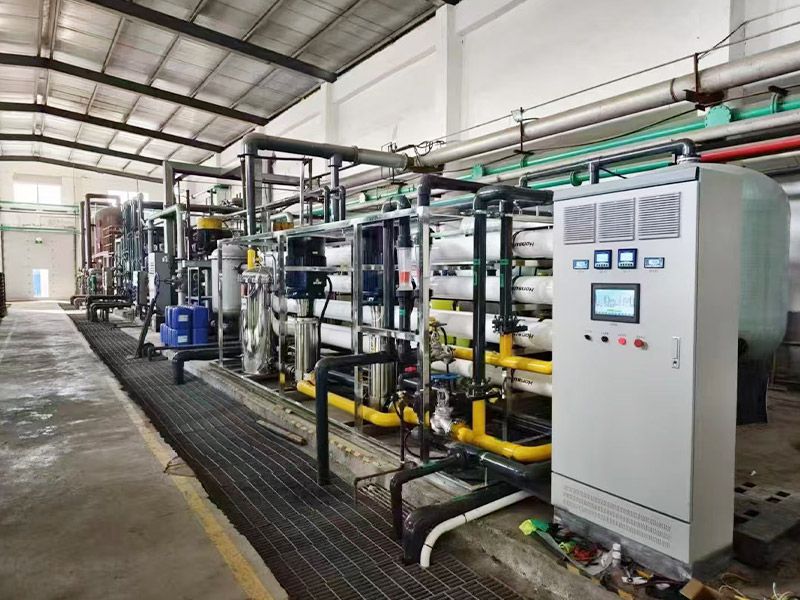
2. Reclaimed water treatment system
There are many subsystems in this system that can deal with all aspects of sewage. The main systems are described below.
1. Water quality clarification system, as the main equipment of lime pretreatment, the role of the clarification tank is to clarify and soften the future water, and use the sludge accumulated in the pool to contact and adsorb the impurity particles in the raw water to achieve the structure of rapid separation of clean water. The mechanical stirring clarifier is to make the raw water added with the chemical in the flocculation chamber and the second flocculation chamber contact and quickly mix with the high concentration of reflux sludge by lifting the impeller and the stirring slurry, forming a large and heavy flocculate, which is separated in the separation chamber. The bottom of the clarifier is equipped with mechanical sludge scraping equipment, which can remove the sludge in time.
2. Variable pore filter system, variable pore filter is a kind of positive flow deep bed filter designed with the theory of "co-directional coagulation", using a filter bed with a larger particle size than the usual filter material and another fine-grained filter material mixed in a certain proportion, and the particle size and proportion of the filter material used in the variable pore deep filter are quite different. The variable pore filter mainly uses coarse filter material, which relies on the entire filter layer for filtration, which avoids the surface filtration of the filter layer formed by ordinary filters, reduces the resistance of the filter layer, and also avoids the premature penetration of suspended solids particles, and can also improve the filtration speed; The addition of fine filter material and mixing it in the filter layer greatly reduces the local porosity of the coarse filter material, improves the flocculation of fine particles in the sewage, is more conducive to the removal of fine particles, and greatly improves the pollution interception capacity of the filter tank. It has the following advantages: high filtration speed, large sewage interception capacity, long operation cycle, good effluent quality, and low backwash water consumption.
3. Lime dosing system and others, when adding lime milk to water, need to be completed by lime pulping equipment and lime milk pump, which can prepare the appropriate concentration of agent according to the water quality, which is conducive to the cohesion and sedimentation of fine particles and reduce the hardness and alkalinity of water. In addition, flocculants and coagulants can be added to the water according to the process at each stage to reduce the turbidity and organic matter content in the water.
4. In the effluent situation, after deep treatment of reclaimed water, the effluent can achieve the following indicators: turbidity: ≤2.0NTU Ammonia nitrogen: ≤3.0mg/L Total phosphorus: ≤1.0mg/L pH: 6-9 Total hardness: ≤4.0 mmol/L Alkalinity: ≤4.0mmol/L COD: ≤20mg/L BOD: ≤10mg/L
This effluent index can fully meet the requirements of circulating water replenishment water quality of Qufu Power Plant.
III. Analysis of Application Situation
The technology of fully using reclaimed water for power plant circulating water make-up is still not very mature, and there are some shortcomings in actual operation. However, using reclaimed water for circulating water can save the use of groundwater and avoid local water shortages, which is of positive significance.
1. Problems encountered
It is quite difficult to treat reclaimed water with high suspended solids, requiring complex processes to resolve. Some substances may generate other compounds during the lime softening reaction, which float on the water surface and are not easy to remove. If they enter the filter tank, they can cause compaction and clogging. When the lime slurry system is prepared with an overly high concentration of lime milk, it can lead to scaling and blockage of flow-through equipment. When using reclaimed water, it is necessary to take corresponding measures according to the process flow to control problems at each stage and ensure the quality of the water output.
2. Analysis from the perspective of benefits
Using reclaimed water in a power plant process requires additional equipment, instruments, and labor costs, which undoubtedly increases the company's expenses. However, comparing the normal production process with this method shows that using reclaimed water can create more benefits for the company. This requires attention to water quality monitoring and regular maintenance of equipment. In daily production and life, careless control of water usage, and even some companies directly discharging wastewater, has impacted local water quality. By adopting reclaimed water for production make-up, power plants turn waste into a resource, not only protecting the local environment but also generating economic benefits for the company.