
I. Design Basis:
1. Water source quality test report or water sample, inlet water pressure and flow rate.
2. Treatment requirements and purpose, treatment capacity.
II. Introduction to Common Processes:
Raw Water Tank → Raw Water Pump → Media Filter → Antiscalant Dosing System → Precision Filter → High-Pressure Pump → Reverse Osmosis System → Pure Water Tank
1. Raw Water Tank
The function of the raw water tank is to store raw water so that when the incoming water supply is insufficient, there is a reserve to provide a stable and sufficient water source for the subsequent reverse osmosis system. Additionally, raw water contains a certain amount of sediment and air (especially surface water), which can affect the normal operation of the equipment. The raw water tank also has functions of sedimentation and aeration to protect the equipment.
The incoming water is municipal tap water with some pressure. A solenoid valve and liquid level switch need to be added to achieve automatic water replenishment when water is low and automatic stop when the tank is full.
2. Raw Water Pump
Provides 0.25-3.5 MPa pressure for the operation of the sand filter and carbon filter. It is recommended to use pumps from Hangzhou South Water Pump.
3. Media Filter Tank
Function: The filter media has both adsorption and filtration effects, which is more conducive to the removal of impurities in the water. It also has advantages such as large specific surface area, low filtration resistance, good anti-pollution properties, and strong acid and alkali resistance. Another unique advantage of the filter media is that through optimizing the media and filter design, the filter can operate adaptively. The media is highly adaptable to raw water concentration, operating conditions, and pretreatment processes. During filtration, the filter bed automatically forms a graded structure with a looser upper layer and denser lower layer, which helps ensure water quality under various operating conditions. During backwashing, the media fully disperses, achieving good cleaning results. The filter can effectively remove sand, manganese, rust, mechanical impurities, and suspended particles in the water, resulting in treated water turbidity of less than 1 NTU.
4. Antiscalant Dosing System
The use of antiscalants for softening mainly removes hardness from the water. Reverse osmosis membranes are the key components of a reverse osmosis system. During long-term continuous operation, calcium, magnesium, and other ions in the water continuously precipitate and adhere to the surface of the membranes, forming scale that clogs the membrane pores. This leads to increased system water supply pressure and cleaning frequency, decreased water production or desalination rate, and can even cause premature failure of the membrane elements. To ensure the economical and stable operation of a reverse osmosis system, in addition to reliable process design, selection of high-quality membrane elements, and comprehensive operation management, choosing suitable antiscalant dispersants to prevent membrane fouling is a commonly used technical approach. Its main functions include:
a. Chelation and solubilization effect: When an antiscalant dissolves in water, it ionizes to form negatively charged molecular chains. These chains form water-soluble complexes or chelates with Ca2+, increasing the solubility of inorganic salts and thereby preventing scale formation.
b. Lattice distortion effect: Some functional groups in the antiscalant molecules occupy certain positions on the inorganic salt nuclei or microcrystals, hindering and disturbing the normal growth of the crystals, slowing down their growth rate, and thus reducing scale formation.
c. Electrostatic repulsion effect: When dissolved in water, the antiscalant adsorbs onto the microcrystals of inorganic salts, increasing the repulsion between particles, preventing their aggregation, keeping them well-dispersed, and thus preventing or reducing scale formation.
To put it simply, an antiscalant works like laundry detergent: it can adsorb onto or alter the properties of substances on the membrane, making it less likely for scale to form and clog it, but it does not pass through the membrane or damage its structure, and it does not affect the water quality.
5. Precision Filter
A precision filter, also known as a security filter, primarily functions to prevent particles missed by the previous process from carrying into the subsequent process, ensuring the intake water quality requirements for the next stage and protecting its long-term operation. It uses molded filter media to remove fine particles and is installed after a pressure filter to remove fine particles larger than 5 μm, further reducing turbidity to meet the intake water quality requirements of subsequent processes. After passing through the security filter, the water is further purified, optimizing its turbidity and color and ensuring it meets the feed water requirements of the RO system.
Technical features of the security filter: (1) The structure of the security filter meets the requirements for quick replacement of filter elements. (2) A discharge valve should be installed on the water pipe entering the security filter. (3) The filtration precision of the security filter element should be 5μm. (4) The structural material of the security filter is stainless steel.
5. Reverse Osmosis Filtration System
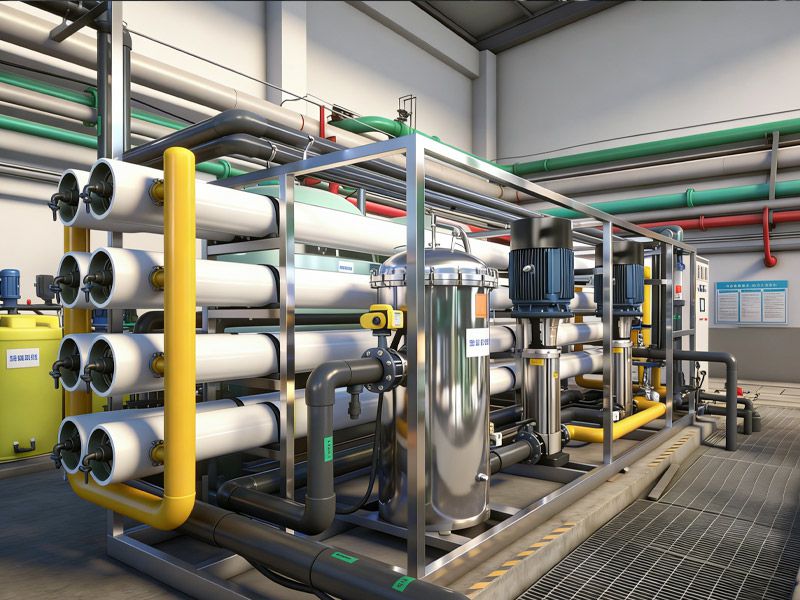
Components: reverse osmosis membrane, high-pressure pump, membrane housing, frame
a. Reverse osmosis membrane:
Osmosis is a physical phenomenon. When two bodies of water with different salt concentrations are separated by a semi-permeable membrane, water from the side with lower salt content will pass through the membrane to the side with higher salt content, while the salt itself does not pass through, gradually equalizing the salt concentrations on both sides. This process takes a long time and is known as natural osmosis. However, if pressure is applied to the side with higher salt content, it can stop the osmotic process; this pressure is called osmotic pressure. If the pressure is increased further, water can be made to flow in the opposite direction, leaving the salts behind. Thus, the principle of reverse osmosis desalination is to apply a pressure greater than the natural osmotic pressure to salt-containing water (such as raw water), forcing water molecules to move to the other side of the membrane, becoming clean water and thereby removing salts from the water. This is the principle of reverse osmosis desalination.